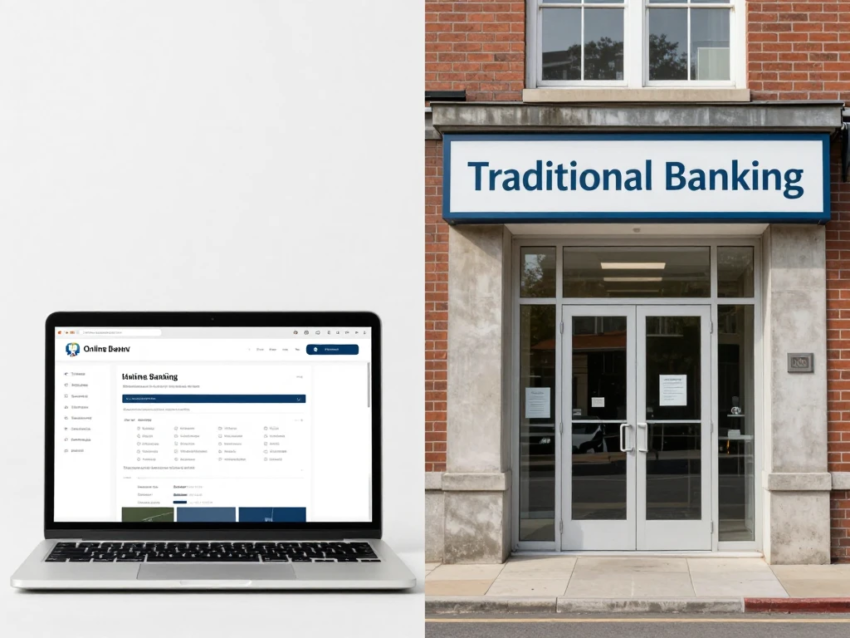
Banking has changed significantly as technology has become part of everyday financial life. Customers can now choose between digital-first banking services, traditional banks with physical branches, or institutions that offer a combination of both.
Online banking allows customers to manage many financial activities through websites and mobile applications. Traditional banking provides access to physical branches alongside digital services. Both models can offer checking accounts, savings accounts, payments, transfers, debit cards, and other financial products.
Understanding the differences between online banking and traditional banking can help you determine which type of banking service fits your needs.
What Is Online Banking?
Online banking allows customers to access and manage their accounts electronically through an internet connection.
Customers can typically use a website or mobile application to:
- Check account balances
- View transactions
- Transfer money
- Pay bills
- Deposit eligible checks
- Manage debit cards
- Download statements
- Receive account alerts
- Manage account settings
Some online banks operate primarily or entirely through digital channels and may not have traditional branches.
What Is Traditional Banking?
Traditional banking generally refers to banks that operate physical branches where customers can receive in-person services.
Customers may visit a branch to:
- Open certain accounts
- Deposit or withdraw cash
- Speak with banking representatives
- Apply for financial products
- Resolve account issues
- Request certain services
Most traditional banks also offer online banking and mobile applications, meaning customers can use both digital and branch-based services.
Online Banking vs Traditional Banking: Key Differences
The biggest difference is how customers access banking services.
| Feature | Online Banking | Traditional Banking |
|---|---|---|
| Physical branches | Limited or none for digital-only banks | Usually available |
| Mobile banking | Usually central to the service | Commonly available |
| In-person assistance | Limited | Available |
| ATM access | Depends on network | Usually established network |
| Digital account management | Extensive | Common |
| Cash services | May be more limited | Often convenient |
| Customer support | Online, phone, or chat | Online, phone, and branch |
| Fees | Vary by institution | Vary by institution |
The actual features and costs depend on the individual financial institution.
Convenience
One of the biggest advantages of online banking is convenience.
Customers can complete many routine banking tasks from a smartphone or computer without traveling to a branch.
For example, a customer may be able to:
- Transfer money
- Pay a bill
- Check a balance
- Review transactions
- Lock a card
- Download a statement
Traditional banks also provide digital banking, but branch-based customers have the additional option of visiting a physical location.
Access to Physical Branches
Physical branches can be important for customers who prefer face-to-face assistance.
A branch may be useful for complicated account questions, certain financial services, cash transactions, or situations where customers prefer speaking directly with a representative.
Online-only banks generally do not provide the same type of branch experience.
Online Banking Fees
Fees can vary significantly between banks.
Some digital-first banks may offer accounts with low or no monthly maintenance fees. Traditional banks may also offer fee-free accounts, particularly when customers meet certain requirements.
Potential banking fees can include:
- Monthly maintenance fees
- ATM fees
- Overdraft fees
- Wire transfer fees
- Foreign transaction fees
- Account service fees
Instead of assuming that online banking is always cheaper, compare the actual fee schedules of the accounts you are considering.
ATM Access
ATM access is another important difference to consider.
Traditional banks often operate their own ATM networks and may have machines near branches and other locations.
Online banks may rely on third-party ATM networks. Some may reimburse qualifying out-of-network ATM fees, while others may charge fees.
If you regularly use cash, check the available ATM network before opening an account.
Interest Rates and Savings Accounts
Savings account rates can be an important consideration when comparing banks.
Digital-first financial institutions may sometimes offer competitive savings rates. Traditional banks can also offer competitive products, although rates vary by institution and account.
Interest rates can change, so always check current account terms rather than relying on older information.
When comparing savings accounts, look at the annual percentage yield, minimum balance requirements, monthly fees, withdrawal conditions, and other account requirements.
Customer Service
Customer support can differ depending on the banking model.
Online banks may provide customer support through:
- Phone
- Live chat
- Secure messaging
- Mobile applications
Traditional banks can provide these options as well as in-person support at branches.
The importance of branch access depends on how you prefer to solve financial issues.
Security
Both online and traditional banks use security technologies to protect customer accounts.
Online banking security may include:
- Multi-factor authentication
- Encryption
- Fraud monitoring
- Biometric login
- Transaction alerts
- Device verification
Traditional banks also use these digital security measures for their online services, while physical branches have additional procedures for in-person transactions.
Customers remain an important part of the security process. Strong passwords, careful handling of verification codes, updated devices, and transaction monitoring are important regardless of the banking model.
Cash Deposits and Withdrawals
Cash access can be an important consideration.
Traditional banks with branches may provide convenient options for customers who frequently deposit or withdraw cash.
Online-only banks may offer ATM access but may not provide branch-based cash services.
If your financial activities involve regular cash deposits, check the bank’s available deposit methods before choosing an account.
Mobile Banking Features
Online banking services often place significant emphasis on mobile applications.
Modern banking apps may provide:
- Mobile check deposits
- Money transfers
- Bill payments
- Card controls
- Spending insights
- Account alerts
- Digital statements
- Biometric login
Traditional banks increasingly offer similar features through their mobile apps, so customers should compare specific applications rather than assuming one banking model automatically has better technology.
Account Opening
Many online banking accounts can be opened remotely.
Customers may complete an application, submit identification information, verify their identity, and fund the account digitally.
Traditional banks may offer online account opening as well, but customers can also visit a branch for assistance.
The application process depends on the institution and account type.
Online Banking for Businesses
Businesses may need additional banking features, making the choice between online and traditional banking more complex.
Business customers may require:
- Payroll services
- Cash deposits
- Business credit products
- Employee debit cards
- Multiple account users
- Transaction approval controls
- Merchant services
- Business loans
A business that handles large amounts of physical cash may value branch access, while a digital business may prioritize online payment tools and integrations.
Advantages of Online Banking
Online banking can provide several benefits.
Easy Account Access
Customers can access their accounts through digital devices without visiting a branch.
Convenient Payments
Bills and transfers can often be managed directly through banking apps.
Digital Record Keeping
Electronic statements and transaction histories make financial records easier to access.
Account Alerts
Customers can receive notifications about transactions and other account activity.
Digital Account Management
Many routine tasks can be completed through an app or website.
Potential Limitations of Online Banking
Online banking also has potential limitations.
Customers who prefer face-to-face service may find digital-only banking less convenient.
Cash deposits may be more difficult depending on the bank’s available network.
Technical problems, internet access issues, or application outages can also temporarily affect access to digital services.
Advantages of Traditional Banking
Traditional banks can provide benefits such as:
Physical Branch Access
Customers can speak directly with bank representatives.
Cash Services
Branches can make certain cash-related transactions more convenient.
Personal Assistance
Customers may prefer discussing complex financial questions in person.
Multiple Service Options
Many traditional banks combine branches, ATMs, websites, mobile applications, and telephone support.
Potential Limitations of Traditional Banking
Traditional banking may involve higher operating costs because of physical branches, although account fees vary widely.
Branch hours may also limit when customers can receive in-person assistance.
However, online banking services offered by traditional banks can provide account access outside normal branch hours.
Which Banking Model Should You Consider?
Instead of choosing based only on whether a bank is online or traditional, compare the features that matter most to you.
Consider:
- Do you need physical branch access?
- How often do you use cash?
- How important are mobile banking features?
- What fees will you pay?
- What ATM network is available?
- What customer support options are offered?
- What savings rate is available?
- What security features are provided?
- Do you need specialized business or financial services?
Your answers can help you identify the banking model that matches your financial habits.
Can You Use Both Online and Traditional Banking?
Yes. Many customers use multiple financial institutions or combine digital and traditional services.
For example, someone might use a traditional bank for branch access while maintaining a separate online savings account.
Others may use a traditional bank’s mobile application for everyday banking and rely on branches only when necessary.
The important consideration is understanding the fees, terms, security features, and services associated with each account.
Online Banking Trends in 2026
Digital banking continues to develop in 2026.
Financial institutions are investing in:
- Artificial intelligence
- Automated fraud detection
- Biometric authentication
- Digital identity verification
- Personalized financial tools
- Faster payment systems
- Mobile-first banking experiences
Traditional banks are also expanding their digital services, which means the difference between online and traditional banking is becoming less distinct.
Final Thoughts
Online banking and traditional banking both provide useful financial services, but they differ in how customers access and manage those services.
Online banking emphasizes digital convenience, mobile applications, remote account management, and electronic transactions. Traditional banking adds physical branches and face-to-face support while also offering many digital services.
When comparing the two, look at fees, ATM access, customer support, security, savings rates, cash services, mobile features, and account requirements.
Rather than focusing only on the banking model, compare the specific account features and conditions offered by each financial institution. This approach can help you choose banking services that fit your everyday financial needs.